AI & NLP, 2026
Fake Job Posting Detection
An NLP classifier that flags fraudulent job ads, trained on ~18,000 postings and served through a Streamlit app.
Streamlit apps sleep when idle and can take up to a minute to wake.
- Accuracy (LinearSVC)
- 98.99%
- Precision — fake class
- 0.95
- Recall — fake class
- 0.84
- F1 — fake class
- 0.89
The problem
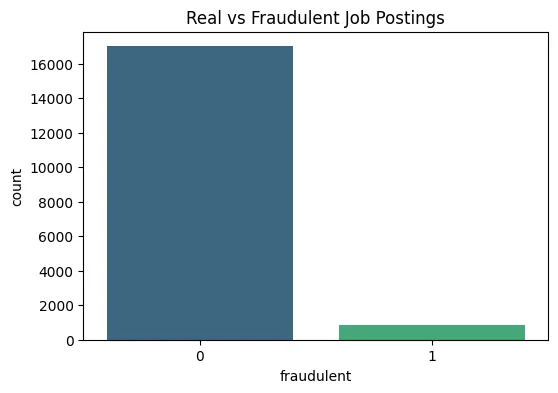
Scammers post fake job ads to collect personal data and money. Only about 5% of postings are fraudulent — a heavily imbalanced dataset — so a naive model can look accurate while missing almost every scam.
What it does
- Combined title, company profile, description, requirements and benefits into one cleaned text feature.
- TF-IDF with unigrams and bigrams; compared Logistic Regression, Linear SVM, Multinomial NB and Random Forest.
- Model selection driven by recall and F1 on the fake class rather than accuracy.
- Streamlit UI with example postings, confidence indicators and input validation for meaningless text.
Method
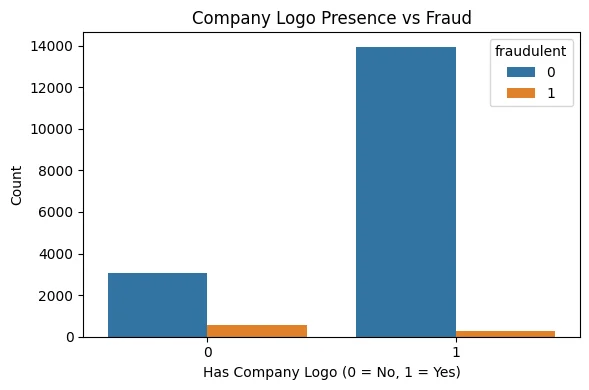
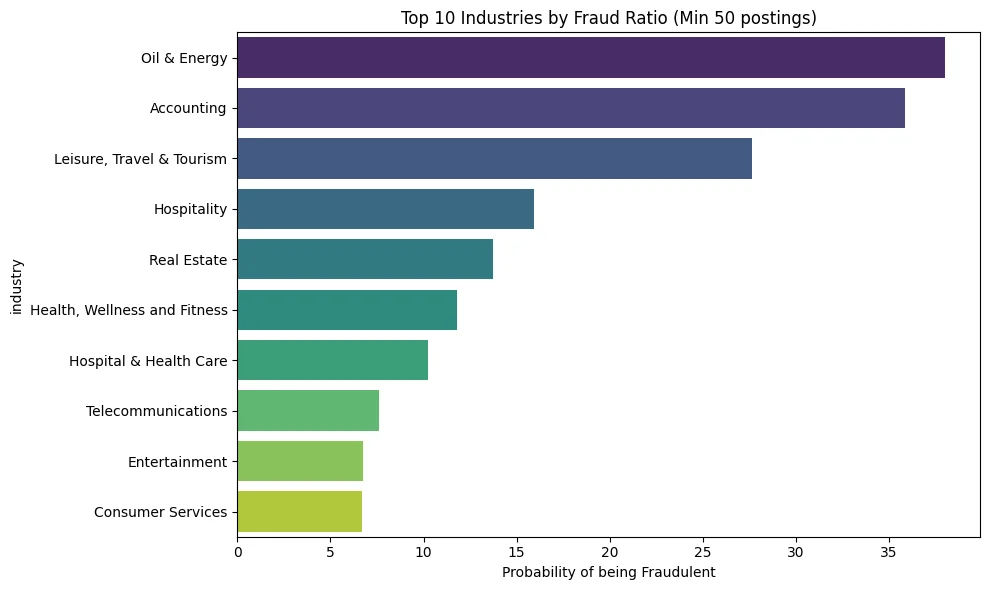
- EDA showed fake postings often lack company logos, push remote roles and use vague, promotional language.
- Text cleaning removed URLs, emails and special characters before vectorisation.
- Four supervised models compared on a held-out test set of 3,576 postings.
Results
- LinearSVC gave the best balance: 145 of 173 fake postings caught with only 8 false alarms.
- Logistic Regression reached higher recall (0.91) but with 35 false positives — a useful alternative if missing a scam is costlier.
Lessons and next steps
- LinearSVC returns a decision margin, not a probability, so inference logic had to treat confidence explicitly.
- The whole pipeline is saved as a single .pkl so preprocessing and model can't drift apart in deployment.
Built with
- Python
- scikit-learn
- TF-IDF
- Pandas
- Streamlit
From the repository
Screenshots and charts as they appear in the project's code and notebooks.